
Zebra game answers: question types and how to answer
Zebra’s questions are short category prompts, and the “answer” is any specific medical term on the editors’ list for that bay. The rarer the accepted answer, the more carrots it earns. Below: what the prompts look like, which specialties the game has used across 21 recorded shifts, and a method for answers that are both accepted and uncommon.
What the questions look like
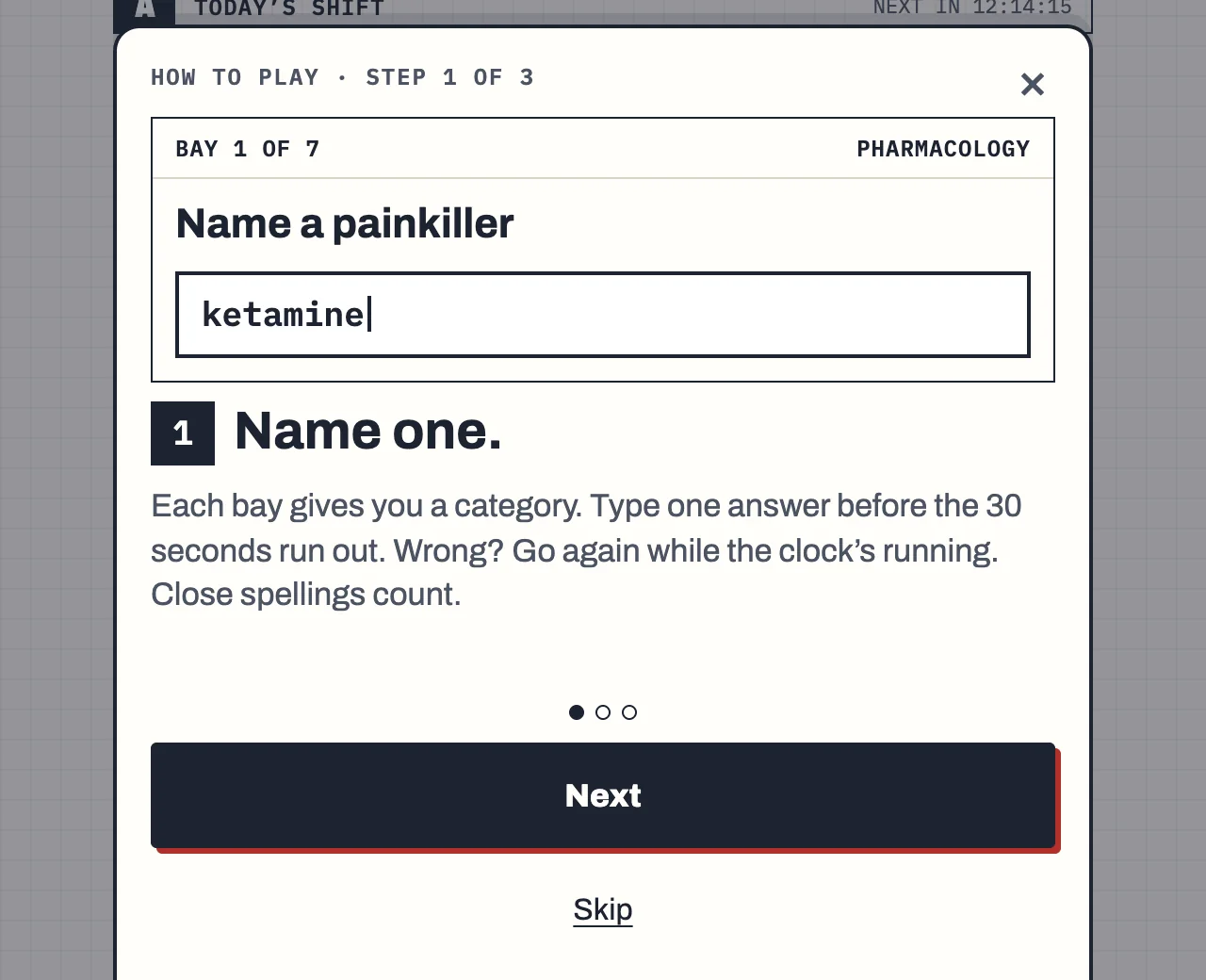
The game shows two examples in its own rules, and both follow the same pattern: a verb, a kind of thing, a topic.
- “Name a painkiller” (Pharmacology, from the how-to-play card).
- “Name a cause of atrial fibrillation” (from the home page’s description of a bay).
The examples suggest a useful reading method: identify the requested kind of thing before choosing a term. A drug, cause, sign, organism, structure, score or investigation calls for a different kind of answer; these are our category examples, not a published inventory of every prompt.
The seven bays, explained
The recorded shifts each show four specialty labels alongside 7 bays. The public list does not map labels to individual bays. Treat a Wildcard label as broad preparation rather than a prediction of a particular question.
Which specialties show up
Source status: 1 publisher (the official public shift list); counts below are our calculation, checked 25 November 2026.
From shift #4 (6 November 2026) to #24 (26 November 2026): 84 labels across 21 shifts, 40 different specialties. The twelve most frequent:
- Anatomy 9
- Medicine 8
- Cardiology 6
- Endocrinology 4
- Gastroenterology 4
- Neurology 3
- Pharmacology 3
- Wildcard 3
- Dermatology 2
- Emergency medicine 2
- Haematology 2
- Immunology 2
All 40 specialties with first and latest shift
| Specialty | Shifts | First seen | Latest | Source status |
|---|---|---|---|---|
| Anatomy | 9 | #4 | #24 | 1 publisher · counts calculated |
| Medicine | 8 | #10 | #24 | 1 publisher · counts calculated |
| Cardiology | 6 | #4 | #23 | 1 publisher · counts calculated |
| Endocrinology | 4 | #4 | #20 | 1 publisher · counts calculated |
| Gastroenterology | 4 | #5 | #20 | 1 publisher · counts calculated |
| Neurology | 3 | #11 | #24 | 1 publisher · counts calculated |
| Pharmacology | 3 | #7 | #18 | 1 publisher · counts calculated |
| Wildcard | 3 | #5 | #12 | 1 publisher · counts calculated |
| Dermatology | 2 | #8 | #23 | 1 publisher · counts calculated |
| Emergency medicine | 2 | #15 | #22 | 1 publisher · counts calculated |
| Haematology | 2 | #14 | #17 | 1 publisher · counts calculated |
| Immunology | 2 | #9 | #12 | 1 publisher · counts calculated |
| Investigations | 2 | #4 | #13 | 1 publisher · counts calculated |
| Ophthalmology | 2 | #10 | #18 | 1 publisher · counts calculated |
| Orthopaedics | 2 | #8 | #21 | 1 publisher · counts calculated |
| Procedures | 2 | #16 | #17 | 1 publisher · counts calculated |
| Psychiatry | 2 | #12 | #24 | 1 publisher · counts calculated |
| Respiratory | 2 | #7 | #16 | 1 publisher · counts calculated |
| Surgery | 2 | #10 | #21 | 1 publisher · counts calculated |
| Toxicology | 2 | #21 | #23 | 1 publisher · counts calculated |
| Acute medicine | 1 | #6 | #6 | 1 publisher · counts calculated |
| Allergy & Immunology | 1 | #20 | #20 | 1 publisher · counts calculated |
| Clinical chemistry | 1 | #22 | #22 | 1 publisher · counts calculated |
| Clinical scores | 1 | #7 | #7 | 1 publisher · counts calculated |
| Clinical signs | 1 | #9 | #9 | 1 publisher · counts calculated |
| Clinical skills | 1 | #16 | #16 | 1 publisher · counts calculated |
| Eponyms | 1 | #6 | #6 | 1 publisher · counts calculated |
| General medicine | 1 | #8 | #8 | 1 publisher · counts calculated |
| Hepatology | 1 | #15 | #15 | 1 publisher · counts calculated |
| Infectious diseases | 1 | #7 | #7 | 1 publisher · counts calculated |
| Microbiology | 1 | #8 | #8 | 1 publisher · counts calculated |
| Nephrology | 1 | #19 | #19 | 1 publisher · counts calculated |
| Oncology | 1 | #21 | #21 | 1 publisher · counts calculated |
| Paediatrics | 1 | #11 | #11 | 1 publisher · counts calculated |
| Physiology | 1 | #11 | #11 | 1 publisher · counts calculated |
| Public health | 1 | #22 | #22 | 1 publisher · counts calculated |
| Radiology | 1 | #14 | #14 | 1 publisher · counts calculated |
| Rheumatology | 1 | #18 | #18 | 1 publisher · counts calculated |
| Sexual health | 1 | #13 | #13 | 1 publisher · counts calculated |
| Urology | 1 | #20 | #20 | 1 publisher · counts calculated |
28 further specialties have appeared less often; they are all in the table above.
How to answer a category prompt
- Pin the kind of thing first. Is it asking for a cause, a drug, a sign, an organism, a score? A rare answer of the wrong kind is still wrong.
- Be specific. Name a single drug, syndrome or structure, not the group it belongs to.
- Go one layer past the textbook line. Consider another specific answer that fits the category, such as a less familiar drug or named syndrome; its actual tier depends on the editors’ list, not this guide.
- Use the clock. Wrong answers cost only time, and close spellings count, so submit and move on rather than polishing one word.
- Do not invent. A made-up or barely related term will not be on the sheet. Rare and right beats rare and wrong.
A checklist for a rejected answer
- Too broad (“heart disease” for a prompt that wants a cause).
- Wrong kind (a disease when the prompt asks for a drug).
- Spelling too far from the accepted form.
- An abbreviation, plural or UK/US variant the sheet does not list.
- Correct, but not on that bay’s sheet. The game uses an editorial answer list; a relevant term may still be missing.
What we publish and what we don’t
Each day gets its own page in the shift archive with the date, the four labels and how often each label has appeared. The prompts themselves stay in the game. To practise on old shifts legitimately, the game’s Archive unlock opens every past day; the strategy page covers how to use that practice without touching your ranked attempt, and scoring covers what each tier is worth.
Questions
Where can I find today’s Zebra answers?
Not here. The answer sheets live inside the game and are not published anywhere public; this page explains the question types and how to answer them instead.
What kind of questions does Zebra ask?
Category prompts such as “Name a painkiller” or “Name a cause of atrial fibrillation”. You type one specific medical term that fits; there are no multiple-choice options.
Which specialties come up most in Zebra?
Across the 21 shifts on record, Anatomy (9), Medicine (8), Cardiology (6) appear most often. The full counts are in the table on this page and update as new shifts are added.
Why was my correct answer rejected?
Usually because it was too broad, the wrong kind of thing for the prompt, too far from the accepted spelling, or simply not on that bay’s answer sheet.
Are the four specialty labels the seven questions?
No. Each shift lists four specialty labels but contains seven bays, so a label can cover more than one bay.
Sources
- Public daily shift list read by the playzebra.io home page · checked 25 November 2026
- playzebra.io home page (rules strip, tiers, stable, today’s shift) · checked 25 November 2026
- playzebra.io FAQ · checked 25 November 2026
- Reddit r/hospitalist: “Has anyone else been playing the medical krillion?” · checked 25 November 2026
- Reddit r/Krillion: “Where do I find the medicine version of this?” · checked 25 November 2026
Updated 26 November 2026